
Cross Hole Sonic Logging Test (CSL)
Confirm number, diameter, and layout of access tubes in pile
Check tube continuity, cleanliness, and water tightness
Flush tubes and fill completely with clean water
Calibrate ultrasonic transmitter and receiver probes
Establish reference signal in sound concrete zone
Lower probes simultaneously into paired access tubes
Transmit ultrasonic pulses at regular depth intervals
Measure wave travel time, energy, and signal attenuation
Repeat testing for all tube pair combinations
Perform full depth scanning of pile shaft
Identify zones of delayed travel time or signal loss
Correlate anomalies with construction records
Generate depth-wise velocity and energy profiles
Classify concrete quality zones
Prepare interpretative CSL report with recommendations
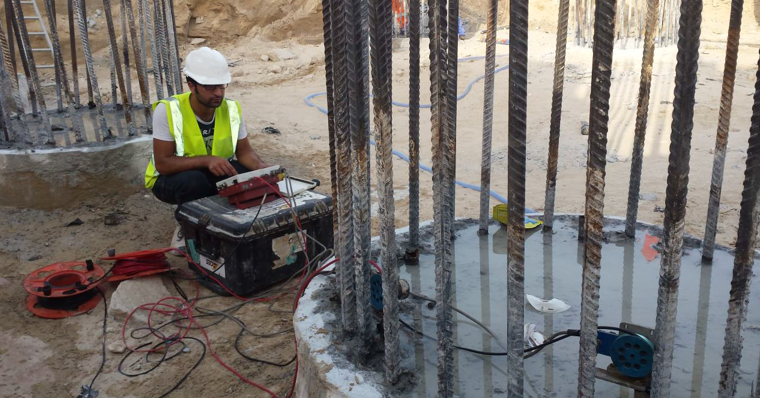
Cross Hole Sonic Logging (CSL) is a non-destructive method designed to assess the internal quality and uniformity of bored cast-in-place concrete piles. It identifies defects such as voids, honeycombing, soil inclusions, or areas of poor compaction. CSL testing is particularly critical in Sri Lanka’s diverse geotechnical environments, where variable soil profiles and moisture content can influence concrete quality.
The test requires the installation of access tubes during pile construction. Ultrasonic pulses are transmitted between pairs of tubes and recorded at multiple depths. Variations in travel time, signal strength, and energy attenuation indicate irregularities in the concrete. By performing scans along the full depth of the pile, CSL provides a continuous profile of pile integrity, highlighting areas that may compromise structural performance.
The final report presents depth-wise velocity profiles, graphical plots, and engineering interpretations, allowing engineers to make informed decisions about structural safety, remedial measures, or construction process improvements. CSL ensures that piles meet design specifications, enhancing long-term durability and minimizing potential foundation risks.
Contact
Reliable soil testing across Sri Lanka
Phone