
Ultrasonic Pulse Velocity Test (UPV)
Review structural drawings and select test locations
Prepare concrete surfaces for proper transducer contact
Apply coupling medium to ensure signal transmission
Calibrate UPV equipment before testing
Place transmitting and receiving transducers
Select appropriate test configuration (direct, semi-direct, indirect)
Transmit ultrasonic pulses through concrete
Measure pulse travel time accurately
Calculate pulse velocity for each test point
Repeat measurements for consistency
Identify low velocity zones indicating defects
Compare results with standard quality classifications
Assess concrete uniformity and homogeneity
Correlate findings with visual inspection
Prepare detailed UPV test report
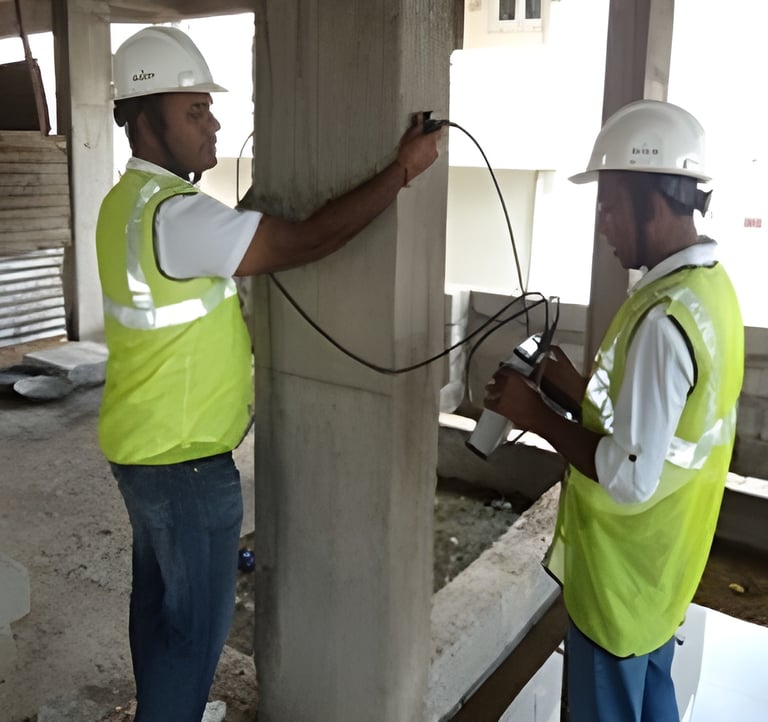
The Ultrasonic Pulse Velocity (UPV) test is a widely used non-destructive evaluation technique to assess concrete quality, uniformity, and integrity. It helps detect internal flaws such as cracks, voids, and honeycombing, providing engineers with valuable insights into the structural health of both new and existing concrete elements. UPV is particularly beneficial in Sri Lanka for infrastructure projects exposed to coastal environments or heavy rainfall, where concrete quality directly affects durability.
During the test, ultrasonic pulses are transmitted through the concrete between transducers placed at known distances. The time taken for the pulse to travel is recorded, allowing the calculation of pulse velocity. Variations in velocity indicate changes in material properties or the presence of defects. Multiple measurements across the surface ensure reliable and comprehensive assessment.
The UPV report includes pulse velocity readings, quality classifications, and interpretations aligned with international standards. These results allow engineers to confirm concrete uniformity, identify compromised areas, and make informed decisions regarding repairs, strengthening, or ongoing monitoring, enhancing structural safety and longevity.
Contact
Reliable soil testing across Sri Lanka
Phone