
Low Strain Pile Integrity Test
Review pile construction records and expected pile length
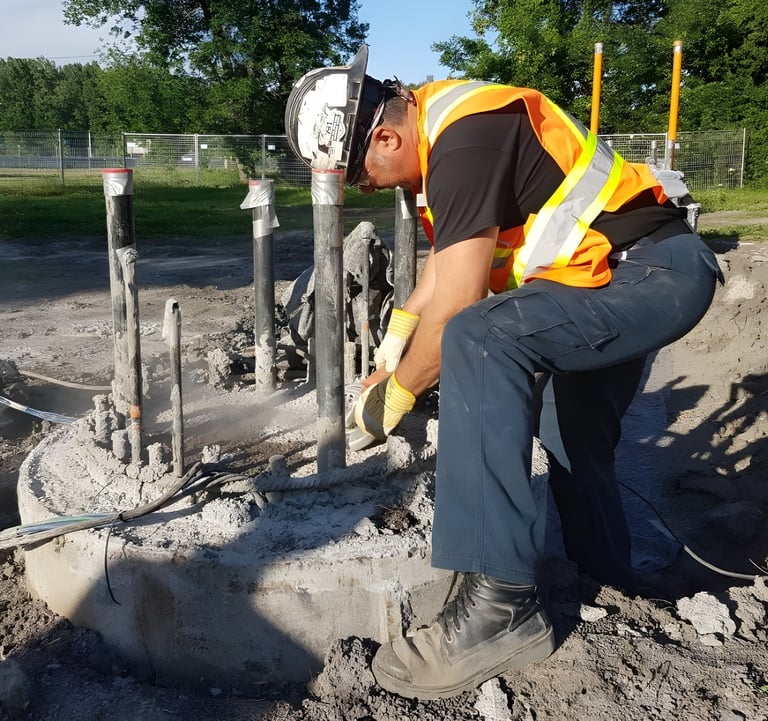
Prepare pile head by removing loose concrete or debris
Mark impact and sensor locations
Install velocity or acceleration sensor on pile head
Verify sensor coupling and signal stability
Apply low energy hammer impacts to pile head
Record reflected stress wave signals
Repeat impacts to ensure consistent results
Filter and process time-domain signals
Identify toe reflection and calculate pile length
Detect impedance changes indicating defects
Assess severity and depth of anomalies
Compare results with design length and soil profile
Classify pile integrity status
Issue technical interpretation and report
Low Strain Pile Integrity Testing (PIT) is a rapid, non-destructive method used to evaluate pile length, continuity, and major defects. It is particularly useful for quality control in large projects where hundreds of piles must be verified efficiently. PIT is widely applied in Sri Lanka to detect issues such as cracks, necking, or incomplete pile sections, especially in varying soil conditions.
The method involves a light hammer impact on the pile head, generating stress waves that propagate through the pile. Reflections caused by the pile toe or any abrupt changes in cross-section are recorded by velocity or accelerometer sensors. Signal analysis allows engineers to estimate pile length, detect major defects, and assess pile integrity without causing structural damage.
The resulting report provides a clear assessment of pile condition, including locations of anomalies and recommendations for further testing or remedial work. PIT testing supports construction quality assurance, reduces the risk of structural failure, and ensures compliance with engineering standards.
Contact
Reliable soil testing across Sri Lanka
Phone